
The RVer’s Guide to Southern Utah’s Dinosaur Tracks and Ancient Petroglyphs
When most travelers pull their rigs into Southern Utah, their itineraries are heavily focused on the breathtaking heights of Zion National Park, the vast expanses of Canyonlands, or the immediate hiking trails surrounding their campsites. However, for those willing to look a little closer at the desert floor and the sun-baked canyon walls, Washington County and its surrounding areas offer something far older than the national parks. This region is a living museum, preserving the footsteps of prehistoric giants and the intricate artistic expressions of ancient indigenous cultures.
Staying at WillowWind RV Park in Hurricane, Utah, places you at the geographical epicenter of these ancient wonders. While you enjoy the modern conveniences of full hookups, shaded sites, and high-speed Wi-Fi, you are only a short drive away from stepping back millions of years in time. This comprehensive guide will take you off the beaten path and away from the crowded shuttle lines, leading you on a historic journey through Southern Utah’s most remarkable dinosaur tracks and petroglyph sites.
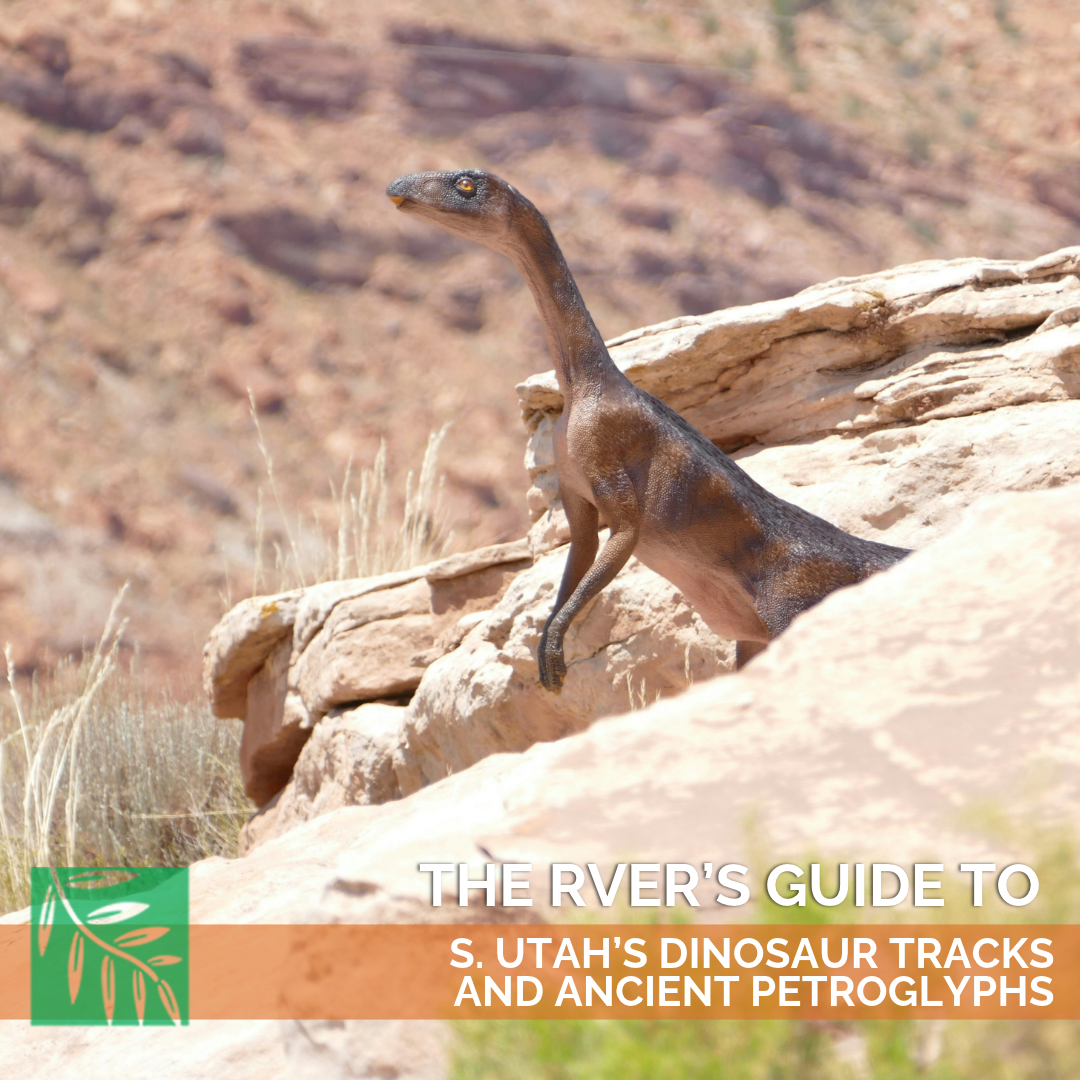
Unearthing the Jurassic: Warner Valley Dinosaur Track Site
Just a short distance from the Hurricane and St. George areas lies the Warner Valley Dinosaur Track Site, an exceptional outdoor destination managed by the Bureau of Land Management. Located specifically in the Warner Valley area of St. George, this site is highly popular with visitors due to its relatively easy access and the extraordinary quality of the preserved trackways.
When researchers first investigated the area, the original number of tracks was thought to be only 161. However, a thorough site investigation conducted in 2010 led to the discovery of over four hundred tracks, and that number continues to grow as both trackways and isolated footprints are analyzed. These impressions are incredibly detailed, with some of the tracks being so well preserved that they clearly display toe pads and claw marks left behind in the mud.
Paleontologists have determined that these tracks are located on top of the Springdale Member of the Kayenta Formation, placing them in the Late Jurassic period, which makes them approximately 190 million years old. The fossilized footprints are preserved in a beautiful, fine-grained reddish-brown and white sandstone. While it is impossible to know with absolute certainty which specific dinosaur species made these tracks, scientists classify them into two main groups, known as ichnogenera, which categorize dinosaurs based on the assumed characteristics of their footprints rather than their bones:
Eubrontes (you-BRONT-tees): These are the larger tracks found at the site. The Eubrontes footprints are widely accepted by the scientific community as being produced by a theropod roughly the size of a Dilophosaurus.
Grallator (GRAL-uh-tore): These represent the smaller tracks. The Grallator footprints at the Warner Valley site are attributed to coelophysid dinosaurs, such as the Megapnosaurus.
To reach the site from Washington, Utah, you will head south on Washington Fields Road, turn left after five miles to head east on Warner Valley Road, and follow this dirt road for about nine miles until you reach the trailhead sign.
The Art of the Ancients: Black Mountain Petroglyph Site
After exploring the dinosaur tracks, you can continue your journey through history by visiting the Black Mountain petroglyphs, which are also located on land administered by the Bureau of Land Management. This site is accessible from the Hurricane and St. George area, making it an excellent addition for a quick day trip from your RV basecamp. The route to the site shoots off from Warner Valley Road, and the drive itself is an easy, well-traveled dirt path.
The Washington County area is home to petroglyphs that date back anywhere from 1,000 to 13,000 years ago. These historical and cultural sites are of immense significance, providing a rare and highly tangible connection to the people who first inhabited the Southern Utah region. Once you arrive at the Black Mountain site, you will find informational displays that explain the massive petroglyph collection and guide you along the hiking trail. The hiking trail itself is rated as easy, making it a fantastic and educational option for families and children.
When visiting, it is crucial to remember the principles of preservation. Preserving these sites honors Indigenous heritage and offers profound educational and spiritual value for future generations. Visitors must practice "Leave No Trace" principles; you should never touch the petroglyphs, and you must take nothing but photographs.
The Crown Jewel of Rock Art: Parowan Gap
For guests willing to take a slightly longer drive north from Hurricane, the Parowan Gap offers what many consider to be the motherlode of ancient rock art in the American West. Located just north of Cedar City on the edge of the Great Basin, this site features a prominent gap in the Red Hills, which was originally carved out by water from an ancient stream.
The walls of the Parowan Gap consist of steep jumbles of weathered and fractured Navajo sandstone, which was deposited during the Jurassic period, 190 million years ago. This natural passage eventually became a frequently traveled path for ancient Fremont Cultures, as well as the ancestors of the Southern Paiute and Hopi People. As these ancient peoples journeyed through the narrows, they stopped to peck and chisel extensive images into the rock. Today, at the western edge of the gap, visitors can view over 1,500 petroglyphs carved into 90 different rock panels.
The carvings vary greatly in size and density, with panels lining both sides of the canyon road. Most of the designs are abstract and geometric shapes, though there are also distinct representations of lizards, snakes, humans, and mountain sheep. The most famous and unusual carving at the site is known as the "Zipper Glyph". Interpretations of this iconic petroglyph vary:
The Paiute Interpretation: The Paiutes say that the Zipper Glyph represents a long trail of hardship in which their great Leader was killed. In this interpretation, the "arms" of the zipper represent the Leader's body shown upside down, with his head at the bottom. Some view it as an inverted man with an arrow in his skull.
The Astronomical Interpretation: Recent studies have put forth the idea that the glyph is actually a complex map or a calendar of solar alignments used to chart celestial movements.
An iron railing has been installed at the site to prevent visitors from touching the fragile rock art. As a bonus for paleontology enthusiasts, if you head exactly one mile east from the gap to a maze of boulders located at the base of a towering cliff of conglomerate rock, you can find another small collection of dinosaur footprints.
Logistics and Preparation for Your Historic Day Trips
Exploring these remote desert sites requires a bit of logistical planning to ensure a safe and enjoyable experience. Because your RV site at WillowWind offers robust amenities, the best strategy is to leave your large rig securely hooked up to power and water at the park. Attempting to navigate dirt trails like Warner Valley Road in a Class A motorhome or while pulling a large fifth wheel is highly discouraged. Instead, take your tow vehicle, truck, or a rented car for these excursions. The Black Mountain Petroglyph Site trail, for example, is accessible by single-track vehicles, high-clearance vehicles, and full-width vehicles.
When packing your day bag, hydration and weather awareness are your top priorities. The Southern Utah desert is an environment of extremes. It is extremely hot in the summer months, so you must bring plenty of water for every person in your party. Furthermore, roads in these remote BLM-managed areas can quickly become washed out and impassable when wet, even if the terrain appears flat. Always check the local weather forecast before heading down a dirt road in Washington County.
Exploring the deep history of Southern Utah offers a profound sense of perspective that perfectly complements the natural beauty of the region. After spending the day tracing the footsteps of Jurassic predators in the Warner Valley or decoding the ancient astronomical maps carved into the Parowan Gap, you can easily return to the modern comforts of your basecamp at the park. Pulling back into your shaded, paved site at WillowWind RV Park allows you to unwind, share your photographs over the high-speed Wi-Fi, and reflect on the incredible layers of time that make the American Southwest a destination unlike any other.
Additional Resources
https://www.recreation.gov/gateways/16388
https://www.onxmaps.com/offroad/trails/us/utah/black-mountain-petroglyph-site-rezkjvgrk6lk
https://www.preservationutah.org/2025-most-endangered-1/washington-county-petroglyphs